
Recently Game Art staff at De Montfort University had the opportunity to catch up with and interview DMU Game Art graduate Fazeel Zaffar, who recently worked on the record-breaking Forza Horizon 6 series as an Environment Artist. Fazeels work helped build the visually complex and beautiful open world road network of Japan. Most recently the game has obtained outstanding scores from reviews and has already amassed over a million players on the leaderboard with over 300,000 players being concurrent daily.
Watch our full interview below to learn more into what it's like to work on the series at Playground Games:
Transcript from Alumni Interview:
Q: Forza Horizon 6 has already surpassed a million players. How does it feel to have your first game credit on such a successful title?
Fazeel: Well, I kind of feel a little lucky about that because just coming out of DMU, I was obviously hoping to get a job, but I wasn’t expecting it to be this early and this full on in the industry. I was quite lucky to be recruited through the degree show; it was a great thing for the industry people to come in and see your work. That’s a great networking opportunity.
Q: What are your day-to-day responsibilities as an Environment Artist at Playground Games?
Fazeel: Specifically, I’m on the Roads team. There’s multiple disciplines in the Environment Art department. We’re about 50 people total in the Environment Art department.
So being on the Roads team, it’s actually one of the more complicated systems at Playground and working on that can be a little challenging. There’s a lot of bug fixing you have to do and triaging. So it takes a little while to get your head around it, but if you’re a little technically minded, which I’d like to think I am, it was all right. I got used to it in the end.

Q: What was it like moving from Unreal Engine at university to Playground’s in-house engine?
Fazeel: Yeah, we use ForzaTech, which has been developed since Forza Motorsport many years ago now, so now it’s been inherited by Playground to make Forza Horizon, and it’s been developed in-house ever since.
It’s very optimized for what we want it to be. Unreal is very good with generalizing things, very easy to use, and it’s really easy to get into for beginners, and then for a more customized engine, it’s obviously a bit more complicated.
Q: Which parts of Forza Horizon 6 are you most proud of working on?
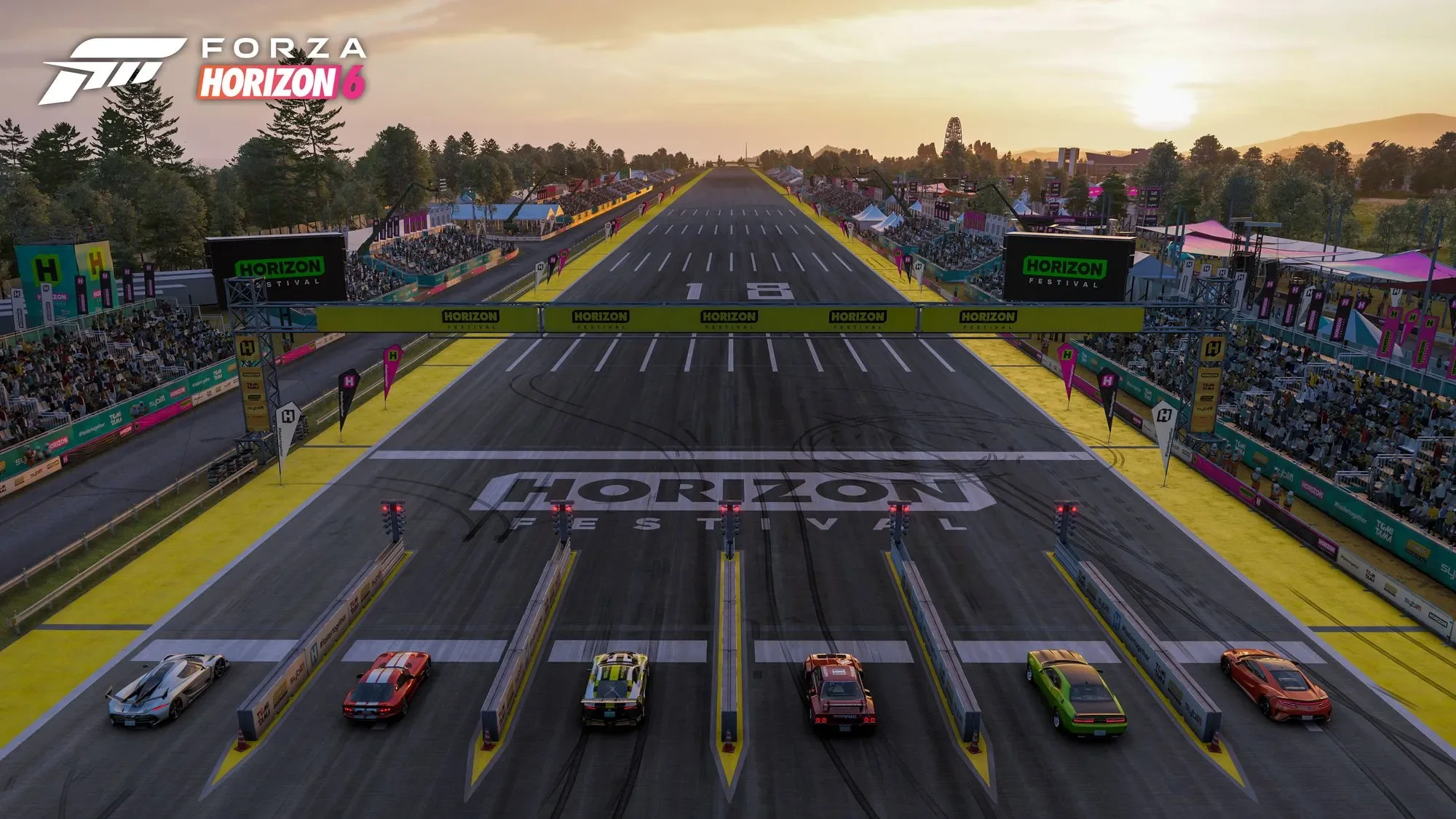
Fazeel: I’m pretty biased by what I’ve worked on lately, so I’ve done specifically the race tracks in Horizon 6. I’ve done the assets for the rumble strips that go around the circuits, the tire marks that are on the roads, multiple textures in different biomes, and then when we get into production, you do certain areas, so you dress up the area with storytelling and potholes and patch repairs and lane lines and such, and you get to storytelling, make it feel a bit lived in.
The race tracks are actually funny in that sense because as I was working on them, just testing things out, Gameplay had already put in some of those time attack circuits, so as I’m waiting for some stuff to update in the background, I’ll just be racing around the circuit.

Q: Has working on Forza made you more interested in cars?
Fazeel: Before I joined, I wasn’t very much of a car guy, but they had the default BMW M4 as this default car, so that used to be the first thing that I started driving around in.
But then as I started doing the track circuits wanting to do better times, there was this Porsche 911 Track GT3 that was a very nice track car, handled great, and so I used to drive around in that. I’m always surprised at how different each car feels, and each car is a new learning curve to kind of get used to.
Q: What advice would you give students moving from university into the games industry?
Fazeel: Getting used to these Unreal workflows is good, but what’s even better is understanding why you’re doing the things you are doing, and that really helps to translate your understanding to a different engine. These workflows change all the time, and they’re never something you stick with, so understanding what the underlying things are is really important.

Q: Looking back at your time at DMU, what helped you the most in your current role?
Fazeel: Well, to me personally the traditional side of it, because I already came from a traditional background, and I loved kind of just taking my time, drawing and relaxing a little bit, getting downtime from that. But that also helps you see about yourself as an artist, and understand what makes something look good and beautiful. So, I think that was quite valuable to learn.
Some people are a bit too technically minded, and don’t understand what makes a good composition, what’s good lighting and values and stuff, and that goes to show in every single work. We use a lot of Substance Designer here, and you’ve got to understand the concepts of big, medium, small and composition, and everything is linked together.
A good game artist is both technical and aesthetic, I would say.
Q: What achievement are you most proud of since joining Playground Games?
Fazeel: A lot of my textures did make it into the game, and there was one specific texture that got showed off and got praise in IGN reviews when I was quite happy about that. It got a direct call out on it. It was the striped roads in the tunnels and stuff, and they look cool for multiple reasons. That was using a road-space texture rather than world-space, which is around most of the world.
Having road-space, we have a lot more linear direction and it gives you a feeling of just a linear road, more linear detail. That was pretty cool to get praised, and a lot of the potholes and the cracks that were made on there were also called out. It was great to see a lot of road appreciation because you’re just driving around at 200 miles an hour and you spend so much time perfecting these things and it’s really nice to be appreciated.
Some people took pictures of the manhole covers, which were uniquely scanned in Japan. Photographers go out in Japan, take these scans and we clean them up and make them ready for the game. It was nice to see people appreciating that too.
Q: How important is real-world reference gathering in your workflow?
Fazeel: It’s crazy. We have photographers that scout out locations on Google Street View, see what locations we want photographed and photogrammetry scanned, and we send them out there. They take the pictures, send them back and we use those as references.
Getting some really nice high-resolution references is really important for getting some clean materials because when I first did the art test for Playground, I was quite surprised how high-resolution the images were and how easily I could base my material off those references because you can see everything that you need to make.
It depends really what asset you’re scanning and putting into the game. A lot of the materials we like to make procedurally because it gives us a lot more flexibility and control on art direction, and using those scans as references is really helpful.
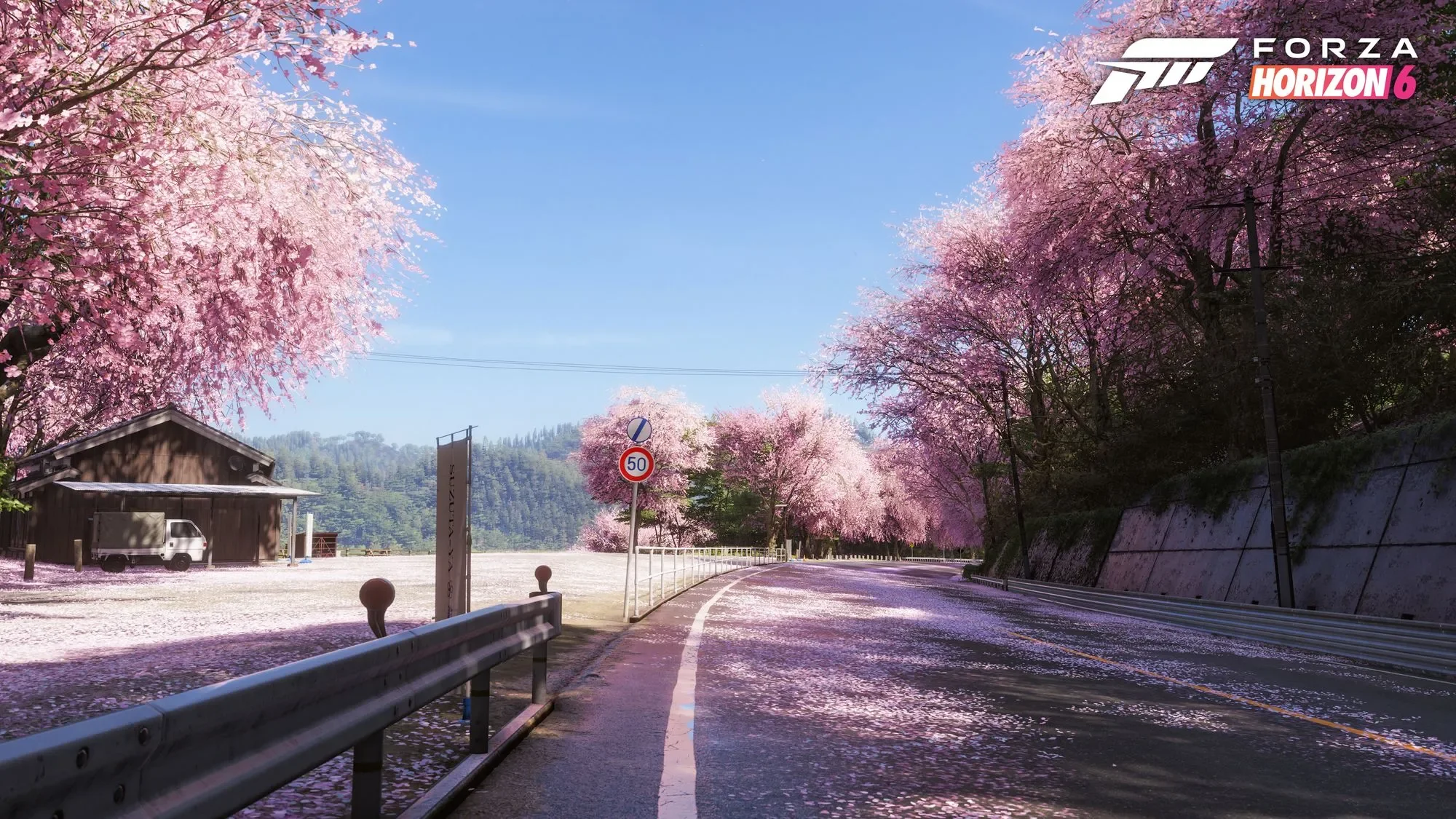
Q: What goes into making roads feel believable in Forza Horizon 6?
Fazeel: Originally, before 6 and 5, all these roads were painted manually almost from scratch.
Understanding the pipeline of the roads with a new system using Houdini and procedural splatting helped proceduralize the blending of these textures and materials.
We would use masks and combine them to get different flows in the road and different cracks and different qualities. If there’s a turn coming up, we’ll use that as a mask to give it a bit more damage, a bit more weathering and stuff.
We have area work where we manually go over those roads adding certain changes to those recipes, making them more aggressive or more clean and using that storytelling to make them more interesting.
It does a really good job in the end.

Q: Would you recommend students learn Houdini?
Fazeel: Houdini is definitely something you should look into if you want to do tech art or you’re a bit more technically minded. I haven’t started that yet because it’s still daunting how big that software is, but it is really cool. We also use it for procedural buildings, so all of Tokyo City was proceduralized with Houdini as well.
Understanding how to use these tools means you can better communicate with tech artists and explain how you’d like the tools to work as well.
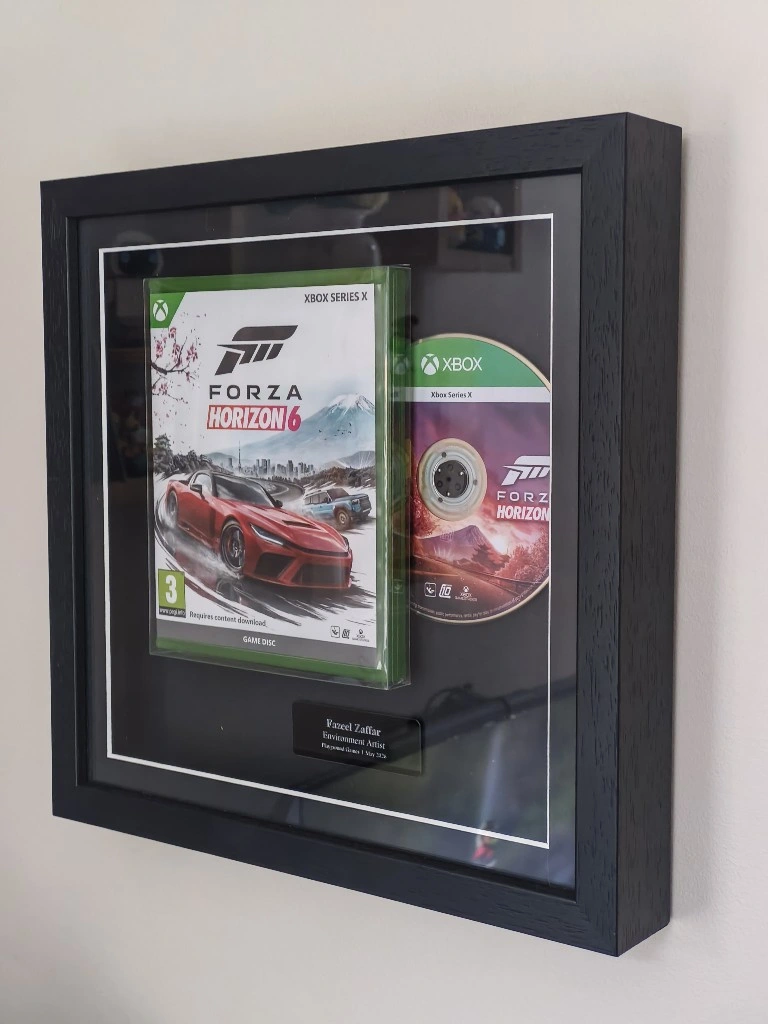
We loved catching up with Fazeel and learning more about his career since graduating from DMU. To discover more creative work from our course come along to our annual degree show to see soon to be graduate student work in person or join us at a future Open Day to speak to staff and students.
Reference list
Forza (2021). Forza Horizon 5: Car Audio Recording Behind-the-scenes. [online] YouTube. Available at: https://www.youtube.com/watch?v=Yqsrizplujs [Accessed 4 Jun. 2026].
GameSpot (2026). Forza Horizon 6 – Official Launch Trailer. [online] YouTube. Available at: https://www.youtube.com/watch?v=p1wFbZwegpk [Accessed 4 Jun. 2026].
IGN (2026). Forza Horizon 6 Review. [online] YouTube. Available at: https://www.youtube.com/watch?v=BoZM70zT5NU [Accessed 4 Jun. 2026].
Microsoft Developer (2018). Photogrammetry and Laser Scanning in Forza Motorsport 7 - Theater Presentation 1. [online] YouTube. Available at: https://www.youtube.com/watch?v=ZGQTH-IuEFc [Accessed 4 Jun. 2026].
Reilly, L. (2026). Forza Horizon 6 Review. [online] IGN. Available at: https://www.ign.com/articles/forza-horizon-6-review [Accessed 4 Jun. 2026].
Zaffar, F. (2025a). Destello - Group Project, Fazeel Zaffar. [online] ArtStation. Available at: https://www.artstation.com/artwork/rJo5zm [Accessed 4 Jun. 2026].
Zaffar, F. (2025b). Fazeel Zaffar. [online] ArtStation. Available at: https://www.artstation.com/faz_fazz_3d [Accessed 4 Jun. 2026].